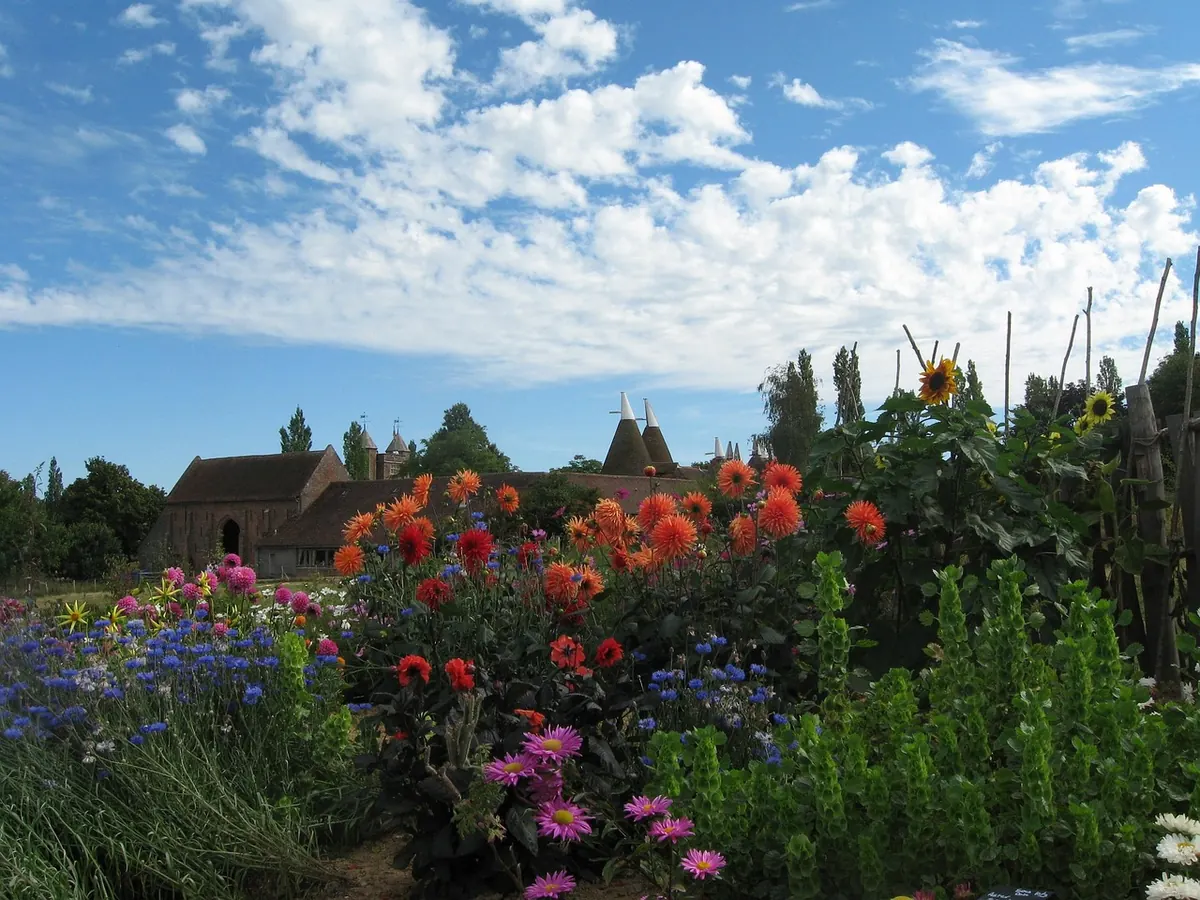
Drive anywhere through the Weald — the belt of clay, orchards and narrow lanes running between Maidstone, Ashford and the Sussex border — and the landscape starts to repeat itself. Weatherboarded barns. Ragged hedgerows. Then, rising above the trees, a white cone topped with a wooden cap and a wind vane, looking as though it might creak round at any moment. Those are oast houses, and they are the most distinctive buildings in Kent: farm factories built for one very specific job.
What an oast house actually is
The word comes from an old English term for a kiln, and that is the heart of the building. An oast is essentially a small industrial unit for drying hops, the flowers used to bitter and flavour beer. A hop farm could not sell wet hops, and freshly picked hops spoil within a day or so, so every grower needed a drying plant close to the hop garden.
A working oast had three main parts: the kiln, where the fire burned and the hops were dried; the stowage or hopper, a barn-like space where green hops were held before and after drying; and the cooling room, where the hot hops were spread out until they were safe to press into long sacks called pockets. On larger farms the whole thing looks like a terrace of cones joined by a tiled barn, which is exactly what it is.
Why the cone shape matters
The cone is not decorative. Hot air rises, and a tall tapering roof helps draw it steadily upward through the bed of hops rather than letting it swirl and pool. Inside the kiln, a slatted wooden ceiling — the wagon roof — sat above the fire, and the hops were spread on cloths of horsehair stretched across it. Horsehair was used because it would not scorch.
The cowl
On top sits the cowl, the boxy cap that gives oast houses their silhouette. Most are fitted with a long tail vane so the wind keeps them turned away from the prevailing weather, which maintains the draught. Cowls are usually painted white, though black, green and unpainted timber are all common. Many were turned by hand by a worker on the kiln floor using a small wheel and chain.
Heat, not fire
The skill was in the temperature. Hops needed warm, dry air moving through them for several hours — fierce heat would drive off the aromatic oils that give beer its character and ruin the crop. Dampers and vents were adjusted constantly. In some yards a little sulphur was burned in the kiln to keep pale hops pale, a practice that faded as brewing tastes changed.
Why Kent ended up full of them
Hops like deep, moisture-retentive soil and a bit of shelter, and the Weald provided both. Just as importantly, Kent sat close to London and its enormous brewing trade, and the railways made it easy to move sacks of dried hops to market. For roughly a century from the mid-1800s, hop growing was one of the county's great industries, with gardens stretching across the Low Weald around Cranbrook, Marden and Biddenden, and further east around Canterbury and Faversham. Wherever there were hop gardens, there were oasts. That is why the cones cluster in the same few parishes rather than spreading evenly across the county.
A season in the hop garden
The oast only made sense as part of a yearly cycle, and the busiest weeks came in September.
- Spring: hop bines were trained up strings of coir or wire strung between tall poles.
- Summer: the gardens grew into dense green walls, and growers watched for downy mildew and aphids.
- Early autumn: pickers pulled the bines down and stripped the cones by hand. For decades, whole families came out from London by train for a working holiday, sleeping in hoppers and huts on the farms.
- Drying: the cones went straight to the kiln, then to the cooling floor, then into the press.
- Late autumn: the dried hops were pressed into pockets, stamped with the grower's mark and sold on to brewers.
From hop kiln to family home
Kent's hop acreage fell steadily through the twentieth century as imports increased and the trade consolidated. The final blow was mechanisation: from the 1950s onwards, picking machines replaced the armies of seasonal workers, and larger, more efficient drying plants replaced the small farm oasts. By the 1960s many cones stood derelict, with collapsed roofs and buddleia growing out of the kiln floor.
Then came the conversion boom. From the 1960s and 1970s, planners and builders began turning oasts into houses, and the shape that made them awkward factories — round rooms, conical ceilings, a kiln floor sunk below the rest of the building — made them desirable homes. Today a converted oast is one of the most recognisable property types in the county, and most are still lived in. The tall round rooms can be chilly and hard to heat, and the kilns often become stairwells or dramatic sitting rooms.
Where to see good examples in Kent
You do not need a map of hop farms to find them. These are the areas where the cones are thickest on the ground:
- Cranbrook, Sissinghurst and Goudhurst — lanes and farm drives lined with white cowls.
- Biddenden, Smarden and Frittenden — a classic Wealden cluster, best seen from minor roads.
- Marden, Staplehurst and Headcorn — several large multi-kiln oasts visible from the roads between the villages.
- Paddock Wood — the Hop Farm, a former working hop farm with a striking group of oasts beside the old gardens.
- Yalding and the Medway valley — smaller oasts tucked into farmyards above the river.
- Kent Life, near Maidstone — a heritage farm park where rural buildings and a hop garden show how the work was done. Check opening times before you travel.
How to read an oast from the lane
Once you know what you are looking at, the buildings start telling you about the farm they served.
- Count the kilns. One cone means a smallholding; three or four joined by a stowage suggests a serious commercial grower.
- Round or square. Round kilns dominate in Kent, but square ones exist here too and are more common in some other hop counties.
- Look at the roof. Traditional coverings are small clay peg tiles, hung on oak pegs, which is why they look so textured from a distance.
- Find the vanes. A cowl still fitted with its winding gear and tail is usually a sign of a careful restoration.
- Mind the privacy. Almost every oast you pass is a private home. Admire from the road or from a public footpath rather than walking up a drive.
Planning your own oast-spotting drive
The simplest route is a loop through the heart of the Weald: pick up the lanes around Biddenden, run north through Smarden and on to Headcorn, then cut across towards Marden and Staplehurst before heading back by way of Cranbrook. Allow a couple of hours, and expect to stop more often than you planned.
Two timing tips are worth remembering. In summer, hedges and foliage hide half the cones; late autumn and winter, when the trees are bare, are the best months for seeing them properly. And if you want the full picture, visit in September, when the surviving hop gardens are at their most striking and the connection between the crop and the buildings is obvious.
If you plan to walk rather than drive, use the public rights of way marked on Ordnance Survey maps of the area, keep to the paths, and close any gates behind you. Several oasts sit on working farms, so treat every yard as private land unless there is a clear welcome.
Photo: ianj1 / Pixabay